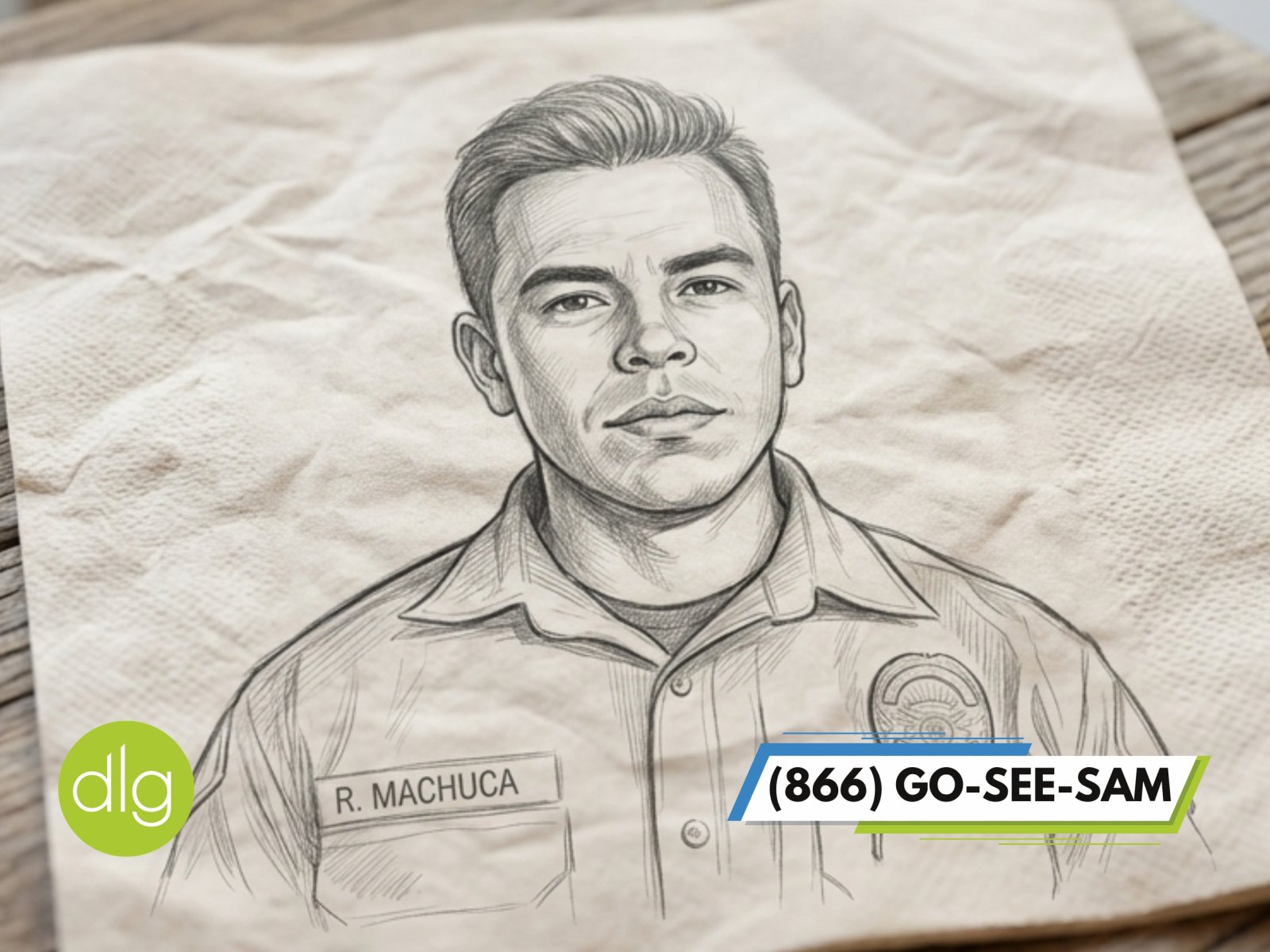
Former Garden Grove police officer Roberto Machuca has been charged with multiple felony sex crimes involving a 16-year-old girl who participated in the department’s Explorer Program. If your child took part in a police Explorer program, a cadet program, or any youth law enforcement program in Orange County, you may have questions about what happened and what your family can do now.
This guide explains the criminal case, the separate civil claims that survivors can bring under California law, who can be held financially accountable, and how to speak with an experienced and compassionate sexual abuse lawyer privately and at no cost.
Call the Dordulian Law Group SAJE Team at (866) GO-SEE-SAM for a free and completely confidential consultation.
Orange County prosecutors have charged Roberto Machuca, 32, of Riverside, with five felony offenses stemming from an alleged sexual relationship with a 16-year-old participant in the Garden Grove Police Department’s Explorer Program.
The charges include:
According to the Orange County District Attorney’s Office, Machuca had been a Garden Grove police officer since 2018 and previously served as an advisor to the department’s Explorer Program.
Prosecutors allege the sexual encounters with the teenage girl began in May 2026. The department reportedly learned of the alleged relationship on June 26, placed him on administrative leave, and arrested him when he reported for work the following day. He turned himself in on July 28, pleaded not guilty to all counts, and was ordered held on $100,000 bail with a requirement to surrender his firearms and passport. A pretrial hearing is scheduled for August 4 at the Stephen K. Tamura West Justice Center in Westminster.
If convicted on all charges, he faces up to five years in state prison and would be required to register as a sex offender for 10 years. District Attorney Todd Spitzer stated that law enforcement officers hold a position of enormous public trust and that this alleged conduct will not be tolerated among those sworn to protect the community.
“Law enforcement officers occupy a position of immense trust, and he exploited that trust to take advantage of a child for his own sexual gratification,” Spitzer said in a statement. “That conduct will never be tolerated among the ranks of those sworn to protect and serve, and justice will be pursued to the fullest extent.”
Police Explorer programs allow young people between the ages of 14 and 21 to volunteer with a police department and learn about careers in law enforcement. The programs are valuable, and most advisors serve honorably. However, the same structure that makes these programs meaningful also creates the exact conditions predators look for.
California law recognizes this dynamic. A 16-year-old cannot legally consent to sexual contact with an adult, and an authority relationship makes the conduct more serious, not less. If something about your child’s program felt wrong, that instinct deserves a conversation with a lawyer.
A common misunderstanding is that the district attorney is handling the survivor’s case. The district attorney prosecutes a crime on behalf of the State of California. The survivor is a witness, not a client, with no control over charging decisions, plea negotiations, or sentencing. A conviction can send an offender to prison, but it does not compensate the survivor and it does not force an institution to change.
A civil case belongs to the survivor. A sexual abuse lawyer files it on the survivor’s behalf, the survivor decides whether to settle, and the recovery goes to the survivor and their family. The differences matter enormously:
You do not have to choose one or the other. Many survivors participate in the criminal case as a witness while a civil attorney protects their separate interests. Learn more about how these claims work on our sexual assault practice area page.
In cases involving an institution, the individual accused is rarely the only party at fault and is rarely the party with meaningful resources. California law allows survivors to pursue claims against the organizations that created the opportunity for abuse and then failed to stop it. Depending on the evidence, potentially responsible parties in a police youth program case can include:
The central questions a civil attorney investigates are these: Were there prior complaints or red flags? Did the agency conduct meaningful background screening? Were there written rules against one-on-one contact between adult advisors and minor participants, and were those rules enforced? Was there any monitoring of communication between advisors and teens? Did anyone in leadership know or have reason to know?
Those answers come from personnel files, internal affairs records, policy manuals, phone and text records, and sworn testimony obtained through civil discovery. That is why survivors need their own lawyer rather than waiting to see what the criminal case produces.
California has some of the strongest survivor protections in the country, but the deadlines are technical and depend on when the abuse occurred and how old the survivor was. Getting this wrong can permanently end a claim.
For childhood sexual abuse claims arising on or after January 1, 2024, California eliminated the statute of limitations under AB 452. This law is not retroactive, and it does not apply to adult survivors. However, for abuse alleged to have occurred in 2026, it is directly relevant. Conduct alleged to have begun in May 2026 against a 16-year-old falls squarely within this framework.
Adult survivors are governed by different rules, including AB 250, the Sexual Assault Statute of Limitations Extension Act, and AB 2777, the Sexual Abuse and Cover-Up Accountability Act. Each has its own requirements and filing windows. If you participated in a police youth program in past years and were 18 or older at the time, do not assume your claim is too old until an attorney reviews the dates.
The single most common fear survivors and parents raise is exposure. No one wants their child’s name in a news story or a public court file. California courts routinely allow sexual abuse survivors to file civil cases under a pseudonym such as Jane Doe or John Doe, helping keep the survivor’s identity out of the public record.
Most civil sexual abuse cases also resolve through confidential settlement negotiations rather than a public trial, and many survivors never testify in open court. Your first call with our firm is free and protected. Nothing is filed, and no one is contacted unless you decide to move forward.
Put your child’s wellbeing first. Connect with a therapist experienced in adolescent trauma. Support comes before litigation, always.
Preserve everything now. Save text messages, social media messages, call logs, photos, emails, program schedules, sign-in sheets, and ride-along records. Do not delete anything, even material that feels embarrassing. Screenshot messages and back them up.
Write down what you remember. Record dates, locations, events, the names of other adults present, and anything reported to a supervisor. Memory fades, and details matter.
Do not sign anything from the agency or an insurer. If anyone contacts you requesting a recorded statement or offering a quick resolution, decline politely and speak with your own attorney first.
Talk to a civil attorney before the criminal case ends. Evidence is most accessible early, and waiting for a verdict can cost you important legal options.
Ask questions with no commitment. A consultation is a conversation, not a contract. You can learn where you stand and then decide what is best for your family.
If your child participated in the Garden Grove Explorer Program, or a similar program anywhere in Southern California, and you have concerns about an advisor’s conduct, please reach out. These cases frequently involve more than one survivor, and many people do not come forward until they realize they are not alone.
Choosing a lawyer for a case like this is not like choosing a lawyer for a car accident. You need someone who understands both the criminal justice system and the civil justice system, who has handled cases involving these types of defendants before, and who treats survivors with dignity from the very first phone call. That is what Dordulian Law Group was built to do.
Sam Dordulian is a former sex crimes prosecutor and Deputy District Attorney for Los Angeles County. He spent years putting sexual predators behind bars before dedicating his practice to representing survivors in civil court. That background is not a marketing slogan. It means he understands how investigators build these cases, how defense attorneys challenge survivors, and how institutions often attempt to distance themselves from the individuals they employed.
The SAJE Team exists because survivors deserve more than a case number. We move at your pace, explain every option in plain language, and never pressure anyone into filing.
Yes. Civil and criminal cases proceed on separate tracks. Filing a civil claim does not interfere with the prosecution, and in many cases moving early helps preserve evidence that might otherwise disappear.
A civil case can still move forward. The civil burden of proof is a preponderance of the evidence, which is a lower standard than the beyond a reasonable doubt standard used in criminal court.
Yes, in appropriate circumstances. Public entities can be held liable for negligence in hiring, supervision, retention, and failure to protect minors participating in their programs. These claims involve specific procedural requirements, which is why obtaining legal advice as early as possible is important.
A parent or legal guardian typically brings the claim on the minor’s behalf. California courts also apply protections designed to safeguard a minor’s recovery and privacy throughout the legal process.
Do not assume it is too late. California’s filing deadlines depend on the survivor’s age at the time of the abuse and the year the conduct occurred. A brief consultation can quickly determine whether you still have a viable claim.
Nothing upfront. Dordulian Law Group handles these cases on a contingency fee basis, meaning you pay no attorney’s fees unless compensation is recovered for you.
In most cases, no. California courts routinely permit survivors to file under a pseudonym, such as Jane Doe or John Doe, and most civil sexual abuse cases resolve through confidential negotiations rather than a public trial.
If you or someone you love was harmed by an adult in a position of authority—whether in a police Explorer program, a school, a youth organization, or a workplace—you do not have to carry the burden alone, and you do not have to navigate California law by yourself.
Contact the SAJE Team at Dordulian Law Group at (866) GO-SEE-SAM or visit dlawgroup.com. You can also learn more about our sexual abuse lawyers and sexual assault representation.
Consultations are free, private, and carry no obligation. There is no fee unless we win.
Author

"*" indicates required fields