
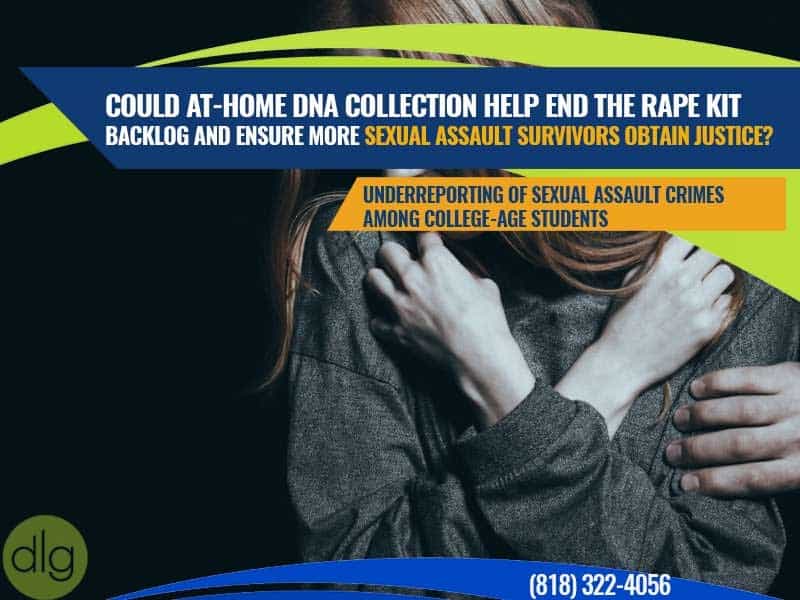
As the rape kit backlog across the nation has generated national headlines, many sexual assault survivors have come to realize that they’ve been let down by the criminal justice system. In some cities like Detroit, critical DNA evidence obtained through thousands of rape kits was never analyzed, but rather left in an abandoned warehouse.
Survivor stories like those featured in the HBO documentary, “I Am Evidence,” have helped inspire the #EndTheBacklog movement and led to additional initiatives aimed at ending the statute of limitations on civil rape claims. But while those efforts should absolutely be applauded and supported, additional measures that might help ensure justice for survivors of sexual assault should also be welcomed.
While researching our recent blog on the importance of having a rape kit completed after a sexual assault (whether for immediate purposes or to give survivors legal options in the future), we came across a private company that has developed an at-home “sexual assault DNA collection kit” that could be a game changer – both in terms of helping to end the backlog and provide survivors with a new evidence gathering option.
That company, Leda Health, offers Early-Evidence Kits for DNA collection after a sexual assault. We spoke with Madison Campbell, the Founder of Leda Health, about her background, what inspired her to create a company that addresses critical but often overlooked needs of survivors, and what products/services are offered.
“Leda Health is a company offering services made by survivors for survivors, and as a sexual assault survivor, myself, who was impacted as a junior in college, looking back on the experience has really changed my perspective in terms of believing more systems should be in place. During that time, I did not choose to report, nor go through criminal or civil proceedings of any kind. I immediately showered after the assault happened, and was really too scared to go and do anything about it. And honestly, I didn’t think anybody was going to take me seriously,” Campbell said.
“Years after the assault occurred, I decided to really come to terms with what happened to me and even though I was unable to seek justice in the general sense of the word – whether that be through either Title IX civil or criminal proceedings – I decided that one of the things I wish I would have done was collected or kept some form of evidence to corroborate my claim. I wish I would have had evidence so that if I ever wanted to move forward – in three, four months or even years later, which is kind of how I felt in the days after the attack – that evidence would have meant that I had something I could have given lawyers to say ‘this is what happened to me.’ But more than that, do I have choices, do I have any options for obtaining justice?”
Campbell says that after undergoing such a traumatic time, when you reach the point of actually processing everything that has happened to you as a survivor, “you really wish that there was some option of preserving that evidence that could have been used in a trial moving forward. And so that’s kind of how we started our company.”
“It was not even part of my process. You know, you think about what you’re taught as a young person, I grew up outside of Pittsburgh, and in sex-ed hardly any options are ever even offered to you as a student – even though it’s a one in four chance for women being sexually assaulted in college. None of that is taught to you in terms of here are your options, here’s how you go to a hospital for an exam, here’s how you collect evidence, none of that was ever taught to me even on a basic level,” Campbell told DLG.
“So it was incredibly foreign, and the only thing I really knew how to do was call 911. And in doing so I found out that my nearest hospital where I could undergo a rape kit was a lot of miles away. And at the time, as a college student, I didn’t have a car, and I would have had to take a bus. And the embarrassment of knowing that I would have had to take a bus to a hospital that was miles away to see a sexual assault examiner just to go through this four to eight hour procedure with all these unknowns, I really didn’t know what was ahead of me and so I gave up. And sadly, I think the system is partly designed for that result – for women to just throw up their hands and say it’s too much to bear after being sexually assaulted. It really highlights how having something like an at-home kit can be so invaluable in terms of convenience, privacy, and ultimately empowerment for the survivor if they ever decide to pursue justice,” Campbell said.
As Dordulian Law Group’s (DLG) partner organization, RAINN (Rape, Abuse & Incest National Network), has confirmed, underreporting among college-age women is overwhelmingly common. In fact, only 20% of female college-age students report sexual assault, while just 32% of non-students in that age category ever report. Overall, only 310 out of every 1,000 sexual assaults are ever reported to the police (meaning more than two out of every three will actually go unreported).
As Campbell told us, Leda Health’s at-home DNA collection kit was designed to help increase access to healing and reporting on the part of survivors. As she points out, many young women, particularly those from communities of color, may be hesitant to report a sexual assault incident to law enforcement or undergo an exam through a kit delivered by a uniformed officer (which, as we’ll discuss in more detail below, was occurring in some parts of the country during the height of the COVID-19 pandemic when sexual assault calls were deemed non-essential cases).
“Instead of using the police, because many young women – specifically minorities, whether it’s indigenous folks of folks of color – do not feel comfortable with having a uniformed official come up to their front door and drop off a rape kit, we’re utilizing a delivery service,” Campbell told DLG.
“We’re actually using DoorDash’s infrastructure to deliver at home sexual assault evidence gathering kits in under two hours to the survivor’s front door. You’ll be able to then pick it up from your doorstep – it’ll kind of look like food delivery, so it will be very discreet – and you can then take it inside and collect evidence time-sensitively in your home, dorm, or wherever you feel safe,” says Campbell.
During the height of the COVID-19 pandemic in April 2020, hospitals deemed sexual assault examinations non-essential services. With sex crime reports suddenly considered non-essential, where were survivors to turn in the event of a rape or other sexual assault matter?
As it turned out, a program initiated in Monterey County, California, supported Campbell’s vision for Leda Health’s at-home DNA collection kit services.
Once sexual assault exams were deemed non-essential, the Monterey County D.A.’s Office stepped in and allowed survivors to perform their own rape kits at home.
“We are taking into consideration the fact that a lot of victims were worried about coming forward, and making a report and we didn’t want to discourage victims from reporting a crime or going to law enforcement, seeking help or seeking treatment because of fears of going to the hospital,” Monterey County Deputy District Attorney, Lana Nassoura, told local KSBW Action News last year.
Initiated through a sexual assault case on April 5, 2020, the at-home DNA rape testing service provided in Monterey County was referred to as a “temporary protocol.”
In terms of the process, Nassoura described the steps last year to KSBW as follows:
Nassoura confirmed the video calls would be done on a secure server which could “not be hacked into.”
“Our priority was to make sure that the victim has access to all the same resources that they would in person,” Nassoura said. “We don’t want people to be discouraged because of fears of getting the virus.”
The Monterey County at-home rape kit initiative serves as an indication of how sexual assault care can evolve to meet the needs of more survivors. Furthermore, it could be viewed as a credible example for why Leda’s Early-Evidence Kits should be supported. And after starting development of Leda’s DNA collection kits over two years ago, Campbell has received such support from some high-profile venture capitalists.
With Leda Health’s at-home DNA collection kit, Campbell says it’s all part of a mission to empower survivors who may not want to seek traditional care to find pathways to healing.
“Those are the survivors we’re trying to empower- because we know that less than 20% of sexual assault survivors actually go to the hospital or receive medical care, and so our thought process was that we can reach primarily young women where they’re at – whether in their dorms, in their first apartments after college, etc. – safe spaces, essentially, where they already are and we can actually provide resources that hopefully will be beneficial,” Campbell told DLG.
Currently, Leda’s kits are available to residents of California, Florida, and Texas (with the initial launch occurring just last week). In order to be eligible for a kit, a survivor must be at least 18 years old and the sexual assault must have occurred within five days (120 hours) of having the kit administered. From there, the next steps include:
Our experienced attorneys can help you pursue a financial award for your sexual assault case. Contact us online or by phone for a free consultation today.
Author

"*" indicates required fields


