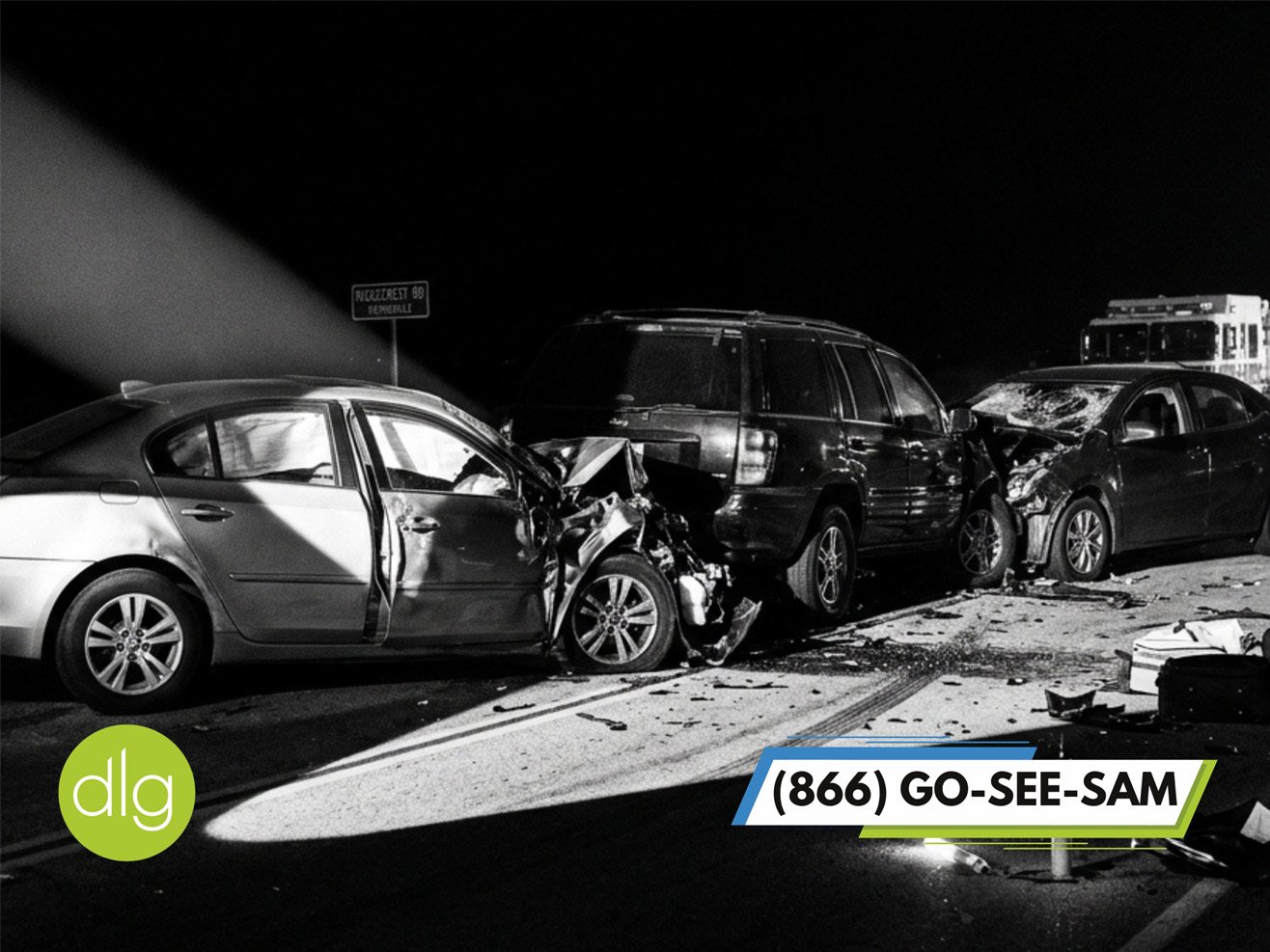
On the evening of Friday, August 14, 2026, two teenage best friends – Maddalyn Dailey and Isabell Hill – were tragically killed in a three-vehicle crash at Ridgecrest Road and Elmwood Drive in Victorville. Both had just started their senior year at Sultana High School. The tragic accident has evoked a number of unanswered questions:
At Dordulian Law Group, we handle California wrongful death cases. We know no article can undo what these families have lost. What this article can do, however, is help explainwhat California law allows a family to pursue through a wrongful death civil lawsuit, and why some deadlines start running immediately.
Under California law, the families of people killed in a suspected street racing crash can bring a wrongful death claim against every driver who participated in the race, not only the driver whose car made contact. If a dangerous roadway condition, such as a dip that hides oncoming vehicles, also contributed, the public agency responsible for that road may share liability under Government Code section 835. Claims against a city, county, or state agency generally must be presented in writing within six months of the death. It’s important to note that this deadline is far shorter than the two-year statute of limitations for claims against private drivers.
According to California Highway Patrol and San Bernardino County Coroner information reported by KTLA, NBC Los Angeles, and Victor Valley News, the crash was reported at roughly 8:30 p.m. on August 14, 2026. Maddalyn Dailey, 17, of Victorville was driving an Acura, turning left from Elmwood Drive onto Ridgecrest Road. Her passenger and best friend, Isabell Hill, 16, of Hesperia, was with her. Maddalyn’s father said she had left home moments earlier to run Izzy home before dinner.
Investigators say a yellow Chevrolet Camaro and a black Dodge Charger were both traveling northbound on Ridgecrest Road at a high rate of speed. All three vehicles collided. The force split the Acura into multiple pieces and fire broke out. Both teenagers died at the scene, and a third person was reported critically injured.
The driver of the Dodge remained at the scene and was arrested on suspicion of gross vehicular manslaughter. The driver of the Camaro fled on foot and, according to authorities, left a child behind at the crash site. As of Monday, August 17, that driver had not been located. CHP has not confirmed that the cars were racing, but witnesses reported seeing them race beforehand, and CHP incident logs referenced possible racing.
Just as significant for a civil case: longtime residents told reporters that speeding on Ridgecrest Road has been a persistent problem for years, that they have repeatedly asked for safety improvements, and that a dip in the roadway makes approaching vehicles vanish from view.
The first version of any crash narrative favors whoever is still standing to tell it. Here, that version is simply that a teenage driver turned left into the path of two oncoming cars. California law is more careful than that.
A driver making a left turn must yield to oncoming vehicles close enough to be an immediate hazard. A vehicle far down the road at a lawful speed is not an immediate hazard. A vehicle traveling at double the speed limit covers that distance in half the time, turning a safe gap into an impossible one before the turn is finished. California’s civil jury instructions recognize this directly: a driver traveling at an unlawful speed forfeits the right of way.
Layer the roadway on top of that. If a dip on Ridgecrest Road conceals approaching headlights from a driver stopped at Elmwood Drive, the sight distance available was never adequate to make the judgment the law asks her to make. That is not driver error. That is a design and maintenance problem, and it is exactly the kind of condition that supports a claim against a public entity.
California also follows pure comparative fault. Even if a jury assigned a percentage of responsibility to a decedent, the family’s recovery is reduced by that percentage rather than eliminated. For a passenger like Isabell, who had no control over the vehicle, comparative fault is generally no defense at all.
Yes. California Government Code section 835 allows a claim against a public entity for a dangerous condition of public property. To prevail, a family generally must show all of the following:
That last element, notice, is often where these cases are won or lost, and it may be the strongest fact here. When neighbors say they spent years asking the responsible agency to address speeding and visibility on a specific stretch of road, those complaints become documentary evidence of notice. So can prior collision reports at the same intersection, traffic studies, speed surveys, petitions, and council meeting minutes.
Conditions that commonly support these claims include obstructed sight distance, a dip or vertical curve that hides oncoming traffic, a missing stop sign or signal at an intersection that warrants one, inadequate lighting or warning signage, and a failure to add traffic calming after repeated notice of a hazard.
Public entities frequently raise design immunity under Government Code section 830.6, arguing that a discretionary approval of the original road plan shields them. That immunity is not absolute. It can be lost when conditions change, when the agency has notice that the approved design has become dangerous in actual use, and when it fails to take reasonable corrective action. We explain this area in more detail here: Can You Sue After a Roadway Defect Car Accident?.
If a public entity may share responsibility, a written government claim generally must be presented within six months of the date of death under Government Code section 911.2. Miss it, and the claim can be barred before a lawsuit is ever filed.
After the claim is presented, the entity typically has 45 days to act. If it is rejected in writing, suit generally must be filed within six months of that rejection. A late claim application may be permitted within one year in limited circumstances, but no family should count on that.
There is a second trap: identifying the correct entity. Depending on the stretch of roadway, responsibility for design, maintenance, and traffic control may rest with the City of Victorville, San Bernardino County, a special district, or the state. Presenting a claim to the wrong agency does not preserve it against the right one.
By contrast, a wrongful death claim against a private driver in California is generally subject to a two year statute of limitations. The six month rule applies to the government claim, and it starts running now.
Fatal crashes rarely have a single defendant. In a case with these facts, potential sources of responsibility can include:
Under California Code of Civil Procedure section 377.60, the parents of an unmarried child who leaves no spouse or children are the parties entitled to bring a wrongful death claim. Recoverable damages generally include:
California places no cap on non-economic damages in an ordinary negligence case, which matters enormously in the death of a child with no earnings history. Punitive damages may be available against a driver whose conduct shows a conscious disregard for the safety of others, a real consideration in racing cases, though they are not available against a public entity.
California’s minimum auto liability limits rose on January 1, 2025 to $30,000 per person and $60,000 per accident, nowhere near adequate in a crash that killed two people and critically injured a third. A thorough workup looks beyond the at fault driver’s policy to the vehicle owner’s policy, any umbrella or employer coverage, and the families’ own uninsured and underinsured motorist coverage.
Uninsured motorist coverage matters especially when one driver has fled and may be uninsured. Do not give a recorded statement to any insurer, including your own, and do not sign a release before speaking with an attorney. Early offers in fatal cases are usually calibrated to close the file before anyone investigates the road.
A roadway defect case is built on evidence with a short shelf life. Families and their counsel should move quickly to:
A prosecution for gross vehicular manslaughter or felony hit and run punishes a defendant. It is not designed to make a family whole, and criminal restitution is typically limited. A civil claim is separate, uses a lower burden of proof, proceeds alongside the criminal case, and can reach defendants the prosecution never touches, including a public entity that failed to fix a road it had been warned about.
Yes, and it is a normal part of these cases. A claim against a driver is in practice a claim against that driver’s insurance policy, not against a grieving family’s personal finances. When multiple parties share fault, California law allows the passenger’s family to pursue all of them.
The case does not end. Liability can still be pursued against the driver who remained, against the vehicle owner, and against any public entity responsible for a dangerous roadway condition. Uninsured motorist coverage may also apply to an unidentified hit and run driver, and fleeing drivers are often identified weeks later through registration, forensic evidence, or witnesses.
Generally two years from the date of death against a private party under Code of Civil Procedure section 335.1. However, you only have six months to present a written government claim if a public entity is involved. When in doubt, treat the six month deadline as the operative one.
California uses pure comparative fault, so a finding of partial responsibility reduces a recovery proportionally rather than eliminating it. Preliminary police conclusions are also frequently revised once speed is reconstructed from vehicle data and sight distance is measured properly.
No. Dordulian Law Group offers free, confidential consultations and handles personal injury and wrongful death cases on a contingency fee basis, which means you never pay a penny unless we recover compensation for you.
Dordulian Law Group is led by Sam Dordulian, a former Los Angeles County Deputy District Attorney with more than 100 jury trial victories, a 98% winning record, and over $150 million recovered for clients. Our car accident lawyers and wrongful death attorneys bring in accident reconstruction and traffic experts early, because roadway defect claims are won with measurements, records, and notice evidence. This includes our in-house private investigator – Moses Castillo – a retired LAPD detective who worked in the elite Central Traffic Division.
Families choose Dordulian Law Group’s Victorville car accident lawyers because they want to know what happened to their child, because they do not want another family on that road to get the same phone call, and because they deserve justice.
If your family lost a loved one in the Ridgecrest Road crash, or in any Southern California collision where speeding, street racing, a hit and run driver, or a dangerous roadway condition may have played a role, we are here to answer your questions at no cost and no obligation. Call (866) GO-SEE-SAM or visit dlawgroup.com for a free, confidential consultation. Consultations are available in English and Spanish.
Dordulian Law Group | (866) GO-SEE-SAM | dlawgroup.com | Free consultation. No fee unless we win.
Our deepest condolences go out to the Dailey and Hill families, to the students and staff of Sultana High School, and to everyone in the Victor Valley community affected bythis tragic loss.
Author

"*" indicates required fields